Hi, I’m Kathleen Doll, PhD, Partner & COO of Intention 2 Impact (I2I), a social impact consultancy known for measuring and communicating impact for foundations, nonprofits, and impact investors. This week our team is taking over AEA 365 to explore what it means to treat impact as a verb instead of a noun.
Today we spotlight how this mindset informs how we function as a firm.
Like many evaluators, we spend a lot of time asking our clients a version of this question: How do your values drive your strategy, decisions, implementation, and outcomes of your work?
It’s also one we have to answer ourselves.
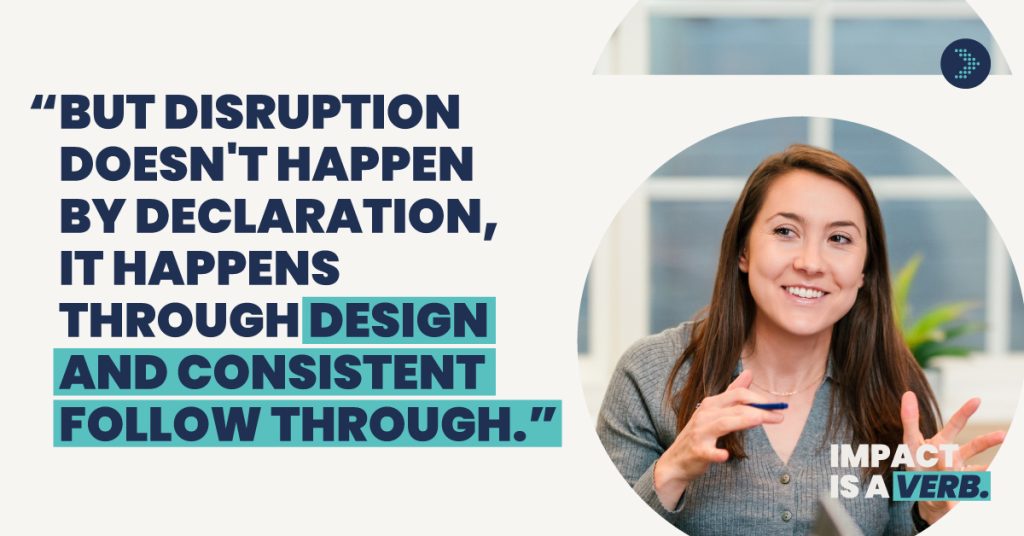
Building an equity-centered, feminist firm is itself an act of disrupting capitalist norms. But disruption doesn’t happen by declaration, it happens through design and consistent follow through. The rubber meets the road via the unglamorous, ongoing work of building systems that reflect our values, measuring whether they actually do, and being willing to be uncomfortable when they don’t.
If impact is a verb, then ours shows up in how we run this firm, not just in the work we deliver, but in the decisions, systems, and practices we build when no one’s watching.
HOT TIP: Start where you have power.
If we’re interested in shifting power and dismantling systems as evaluators, we have to begin where we actually have agency. For us, that’s inside I2I itself. How we hire. How we price our work. How we care for the people doing this work. How we measure our own progress.
Operations aren’t sexy but we love them anyway. Designing systems for people to thrive is the work, but it’s the layer the field rarely sees. Here are 4 LESSONS LEARNED:
- Hiring processes are cultural signals not HR functions. That means publishing salary ranges, sending interview prompts in advance, and closing the loop with every single applicant (especially when the answer is no). In a contracted market full of brilliant evaluators navigating transitions they didn’t plan for, clarity is a gift. Care is a choice.
- Being values-driven costs money, plan for it. We had to reckon with something uncomfortable early on: you cannot use capitalism to break a system while pretending capitalism doesn’t apply to you. Being values-driven costs money. So we built a pricing model that accounts for the true effort of our work. It’s about more than billable hours, it accounts for uncertainty, complexity, and mission alignment. We call it our LoE formula.
- RAD RESOURCE: Developing More Intentional Budgets By Redefining LoE
- Adaptation as an act of care. In 2025, we realized our AI adoption was happening in the shadows, some team members experimenting quietly, others opting out entirely, and all of us assuming we were more aligned than we were. So we hired an outside consultant (s/o to Valerie at Mission Bloom) and did the slow, messy work: listening sessions, shared values mapping, bounded experiments. When our practices feel out of whack with our intended values, we invest the time and resources to slow down and build.
- Measurement is 360. Every year, we compile metrics across five pillars of our business: finance, business development, products and services, marketing, and people and culture. Every team member completes a self-review and a 360. We share progress openly, reset goals together biannually. This is our version of what we ask of our clients: use data to learn, not just to report.
Good intentions are nouns. Closing the gap between what you say and how you operate, that’s the verb. And that’s the work we’ll always be in.