Hi, I’m Emma Hamrick, MPH, an evaluation consultant at Intention 2 Impact (I2I), a social impact consultancy known for measuring and communicating impact for foundations, nonprofits, and impact investors.
This week, our team is taking over AEA 365 to explore what it means to treat impact as a verb instead of a noun: an active practice, not a static goal. Today: what it takes to embed evaluation into a pooled fund designed to shift power to young leaders in the responsible tech movement.
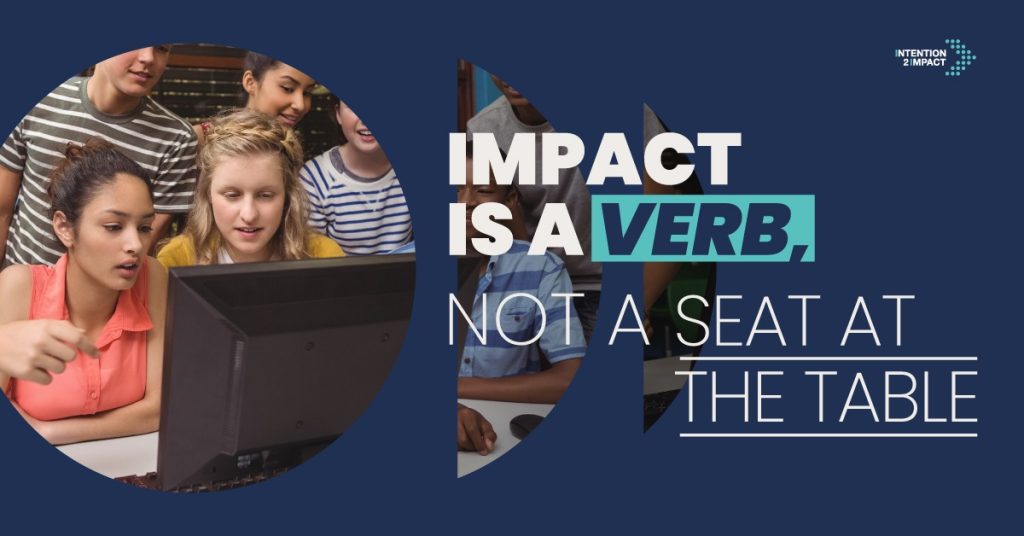
Outside of I2I, I’m involved in young leadership spaces. As a young leader myself, I know from experience that giving young people a seat at the table is not the same as shifting power. A “seat at the table” can often mean being consulted, showcased, or at worst, simply tolerated or tokenized. Power-shifting looks different: our expertise is taken seriously, our input shapes decisions, our time is compensated because it has value. That distinction shaped how we approached The Responsible Tech Youth Power Fund (RTYPF) evaluation.
The Context
RTYPF is a first-of-its-kind philanthropic initiative supporting youth and intergenerationally-led organizations across the responsible tech movement. In its third year, the fund has raised $7 million, with 18 co-funders making a coordinated bet on a shared model that replaces individual grantmaking preferences with a collective strategy and shared governance.
What the Model Was Designed To Do
Over time, the RTYPF model has intentionally evolved. In its current state, one of the design elements that makes RTYPF unique is that it positions young leaders alongside funders on the steering committee, not just as grantees, but as interest-holders and advisors with concrete authority and decision-making power. The grantees don’t share a common program model. They share a belief about who should have power to shape the responsible technology ecosystem, and they bring a diversity of approaches to doing so. That’s a harder thing to measure, and the more important one.
To understand what the model was making possible, we looked at three things: grantee outcomes, model performance, and early ecosystem signals.
What we built
We designed a learning system to track change at multiple levels: young leaders, their organizations, the funders, and the broader ecosystem. The outcomes that matter most are actions, not just accomplishments. That’s measuring impact as a verb, and grantee outcomes only tell part of the story.
Lessons Learned
- The model is part of what you’re evaluating. In a collective funding model, the architecture of how funders pool resources, share power, and structure relationships is the thing. If your evaluation is only measuring what happens downstream of that architecture, you’re measuring the shadow, not the object.
- Follow the power. In a model designed to shift power, the most significant outcomes will show up where power lives. That means looking at funder behavior, governance decisions, and resource flows, not just in grantee reports.
- Build for multiple levels. Grantee outcomes are how you know the model is working. Model outcomes are how you know the broader ecosystem is shifting. Build measurement to capture shifts in multiple levels, and be deliberate up front about which level your framework is designed to illuminate.
To Close…a HOT TIP:
True power-shifting is when the people at the table actually shape what gets decided, not just whether they have a chair. The RTYPF’s design continues to evolve with that in mind, and so does our evaluation. In your next evaluation, ask whether power is actually moving, and build your measurement system to see it when it does.
A seat is a noun. Moving power is the verb. Measure the verb.